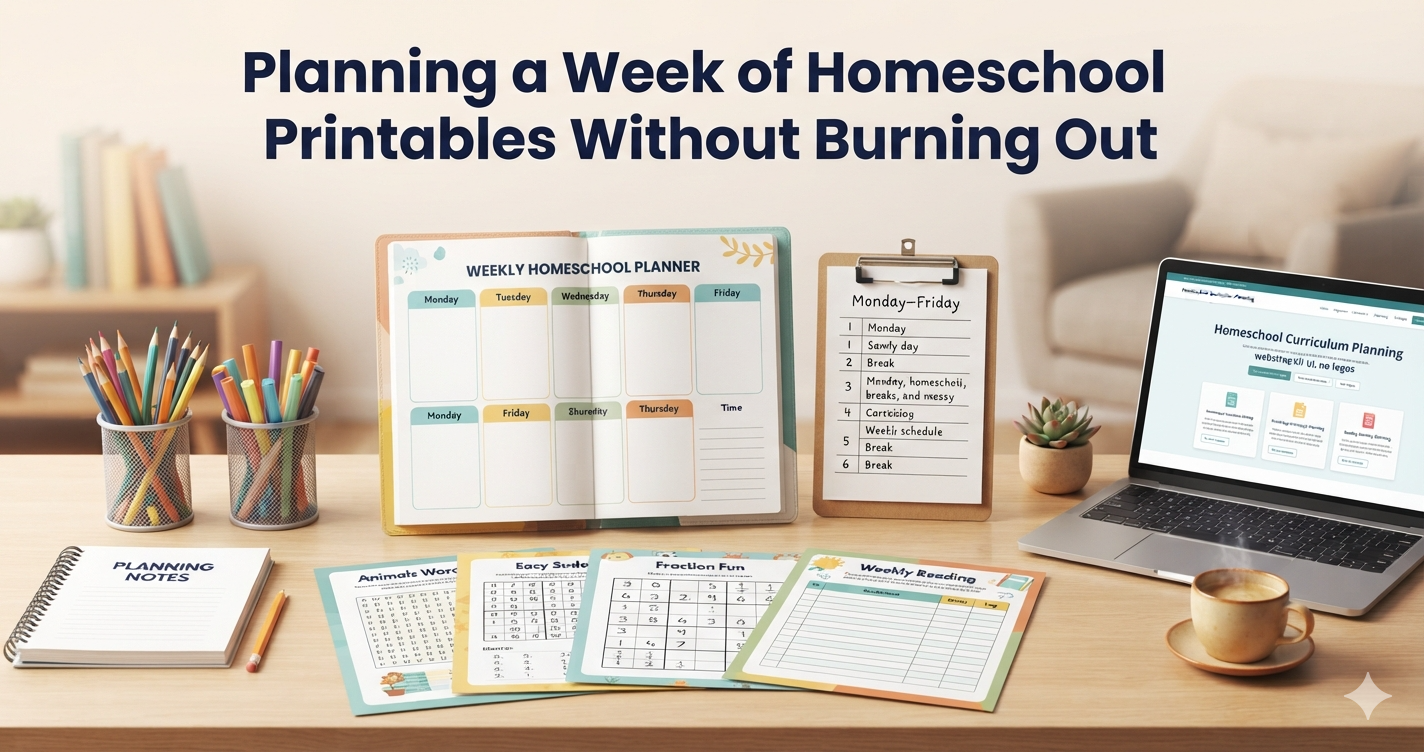
The failure mode in homeschooling is not finding material. There is more free material online than anyone could use. The failure mode is the Sunday evening where you assemble the week from twelve different sources, and then do it again the following Sunday, and the one after.
The fix is not more material. It is a template you fill rather than a week you invent.
One theme, five days
Pick a single theme for the week and let every subject borrow from it. Not because cross-curricular work is fashionable, but because it collapses five planning decisions into one.
A week on 'the ocean' gives you the vocabulary list for spelling, the word bank for the crossword, the reading subject, the subject of the writing prompt, and the counting objects for maths. You chose one thing.
The shape of a week
| Day | Warm-up | Main |
|---|---|---|
| Mon | Word search, new vocabulary | Introduce the theme |
| Tue | Missing letters, same words | Reading |
| Wed | Maze or logic puzzle | Writing |
| Thu | Crossword from the week's words | Project work |
| Fri | Word scramble, revision | Show and tell |
The same word list runs through Monday, Tuesday, Thursday and Friday in four different forms. The child meets the vocabulary four times without doing the same worksheet four times — which is the thing that actually builds retention.
Note the order. Recognition first, then recall, then meaning, then revision. Putting the scramble on Monday would show incorrect spellings of words the child has not learned yet.
Build it in one sitting
Once the word list exists, the puzzles take minutes. The list is the work; everything after it is mechanical.
- Write the week's fifteen words.
- Generate the four puzzles from that one list.
- Print the whole week at once and put it in a folder per day.
- Save the project so next term's revision week regenerates from the same list.
That last step is what makes the second year easier than the first, and it is the one people skip.
For more than one child
Same theme, same words, different difficulty. A six-year-old gets a 10×10 grid with six words; a ten-year-old gets 15×15 with fifteen, including backwards. Same table, same conversation, same subject — and neither is doing work aimed at the other.
It also removes the argument about who got the easier sheet, because they are visibly the same puzzle.
What not to do
Do not make everything from scratch. Generated puzzles are for the vocabulary that is specific to your week; for handwriting practice, number lines and blank calendars, use the same template every week and stop thinking about them.
And do not print a month ahead. Themes change, a child moves faster or slower than expected, and a drawer of unused printouts is a quiet reproach every time you open it.