In any class of thirty, several students will find a standard puzzle sheet harder to use than the person who made it imagined. Not because the puzzle is too difficult — because the page is.
The changes that help are small, cost nothing, and improve the sheet for everybody. What follows is practical design advice, not clinical guidance; a student with a specific diagnosis has support that should lead.
Letter shapes that do not confuse
The letters most often confused are the ones that are mirror images or near-identical in many typefaces: b and d, p and q, and the trio of capital I, lowercase l and the digit 1.
A typeface where those shapes are visibly distinct removes a difficulty that has nothing to do with the puzzle. In a word search this matters more than anywhere else, because there is no surrounding word to disambiguate from — a lone letter has to stand on its own.
Uppercase helps here too, and it is the default for a reason: uppercase B and D are not mirror images, where lowercase b and d are.
Space is the cheapest accommodation
Cramped text is harder for every reader and disproportionately harder for a slow one. Three things to do:
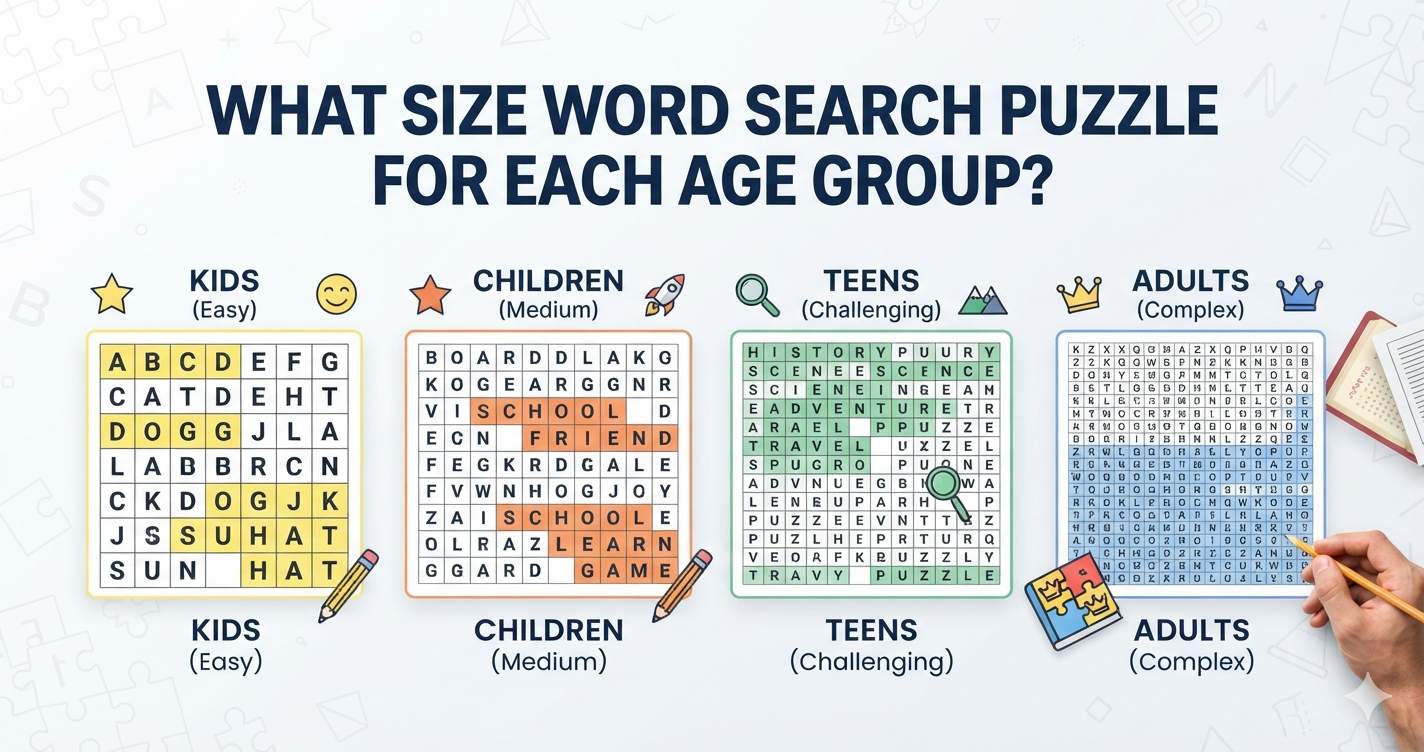
- Fewer cells on the page — a 10×10 grid on a full page gives every letter room to be looked at.
- Shorter word lists set in a larger size, arranged in fewer columns.
- More space between lines in the instructions than looks necessary.
This is the same argument as large print, and the two audiences overlap more than people assume.
Contrast, both ways
Grey grid lines look elegant on screen and cost real effort on paper, especially after a photocopier has been at them. Black lines on white are the safe default.
The opposite problem exists too: for some readers, pure black on bright white glares. Printing on cream or pale-tinted paper is a common, cheap accommodation — and it needs nothing from the file, just different paper in the tray.
Avoid conveying anything by colour alone. If your answer key marks words in colour, make sure the mark also has a shape — a capsule or a line — so it survives a black and white copy.
Reduce what has to be held in mind
A puzzle asks the solver to keep several things in working memory at once. Where that is the difficulty rather than the point, ease it:
- Keep the word list on the same page as the grid, never overleaf.
- Group the list by first letter or by length so scanning it is quick.
- One instruction, in one sentence, at the top.
- For crosswords, keep clues on the same page as the grid even if it means a smaller grid.
That last one gets ignored constantly and it is the single biggest usability failure in printed crosswords: a solver who has to turn the page to read a clue loses their place every time.
Give the same puzzle at two densities
The practical classroom answer is not one sheet for everyone. It is the same words at 10×10 and at 15×15, handed out without comment.
Both students are doing the same activity with the same vocabulary, and neither sheet is labelled as the easier one — which matters more to the student than any of the typography.