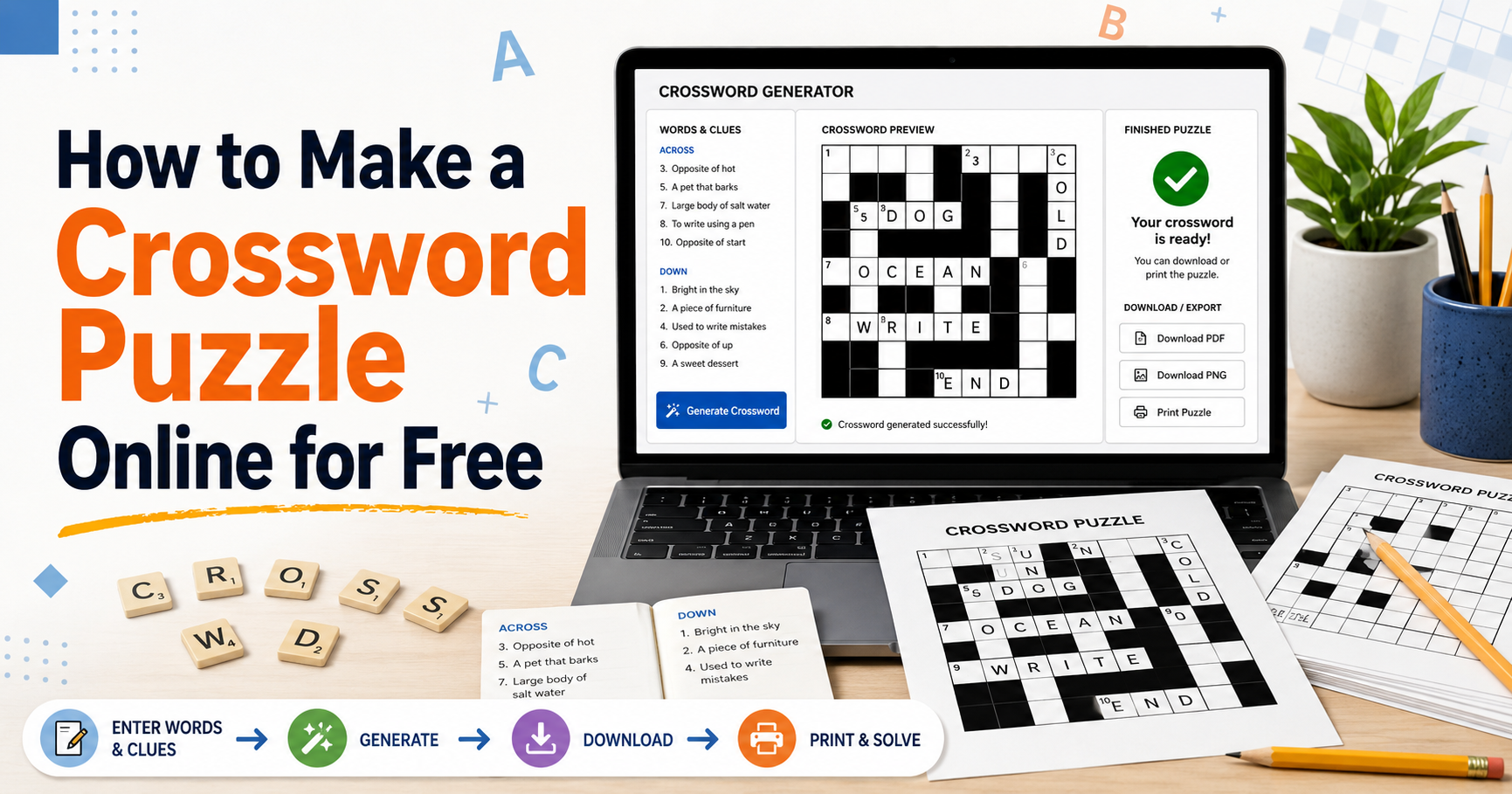
The grid is the easy part. Software fits the words together in a second, and one interlocking grid looks much like another. What separates a crossword people enjoy from one they abandon is entirely in the clues — and clue writing is a craft nobody teaches you.
A definition is not a clue
The default when writing your own crossword is to reach for the dictionary meaning. For ELEPHANT you write 'large grey mammal'. It is accurate, it is fair, and it is dead on the page.
A clue does one more thing than define: it gives the solver a way in that is not simply knowing the word already. Compare:
- Large grey mammal — a definition. You either know it or you do not.
- It never forgets, apparently — the same answer, reached through something the solver already has in their head.
- Room-sized animal nobody mentions — playful, and it gives the length away by implication.
All three are fair. The second and third are the ones people remember.
Pitch it at the person solving
This is where most homemade crosswords go wrong, and it is not about vocabulary. It is about shared reference.
For a classroom
Clue from the lesson, not from the dictionary. If the class spent a week on the water cycle, 'what the puddle does in the sun' beats 'to turn to vapour' — the first rewards attention in class, which is the reason the puzzle exists.
For a party or an occasion
Clue from shared memory. At a wedding, 'where they met, allegedly' is worth twenty dictionary definitions. Nobody attends a wedding to demonstrate vocabulary.
For a book
You have no shared context, so consistency becomes the substitute. Pick a register and hold it for the whole book. Solvers adapt quickly to a setter's voice, and the adapting is part of the pleasure — but only if the voice stays still.
Habits that make it feel professional
- Match the part of speech. If the answer is RUNNING, the clue should read as a gerund — 'moving at speed', not 'to move at speed'.
- Never use the answer, or an obvious relative of it, in its own clue.
- Signal proper nouns. 'Capital of France' tells the solver to expect a name; without the signal they will spend time on ordinary words.
- Vary the length. A page of clues all running eight words long reads as machine-made even when it is not.
- Let a few be easy. Solvers need somewhere to start, and a grid with no entry point gets put down in the first minute.
That fourth one is worth dwelling on. Uniformity is the single strongest signal that clues were generated rather than written. Real setters produce a three-word clue, then a twelve-word one, then a pun, then a plain definition because the word resisted everything else. The unevenness is the fingerprint.
How many words fit
Twelve to twenty-five entries interlock comfortably in a standard grid. Below twelve the grid looks sparse and the crossings do too little work. Past twenty-five, the placement engine starts dropping words it cannot fit, and it may drop the ones you cared about most.
Shorter words cross more easily and produce a denser grid. If you have a list of long words and a small grid, expect losses — either accept a larger grid or shorten the list yourself rather than letting the software choose for you.
Read it as a solver before you print
Leave it a day, then solve your own crossword from the clues, ignoring what you know. Two things surface immediately: the clue that made perfect sense while writing and none at all afterwards, and the corner where three obscure words cross and there is no way in.
That corner is the one that gets your puzzle abandoned. It is always fixable — usually by making one of the three crossings easier — but only if you find it first.