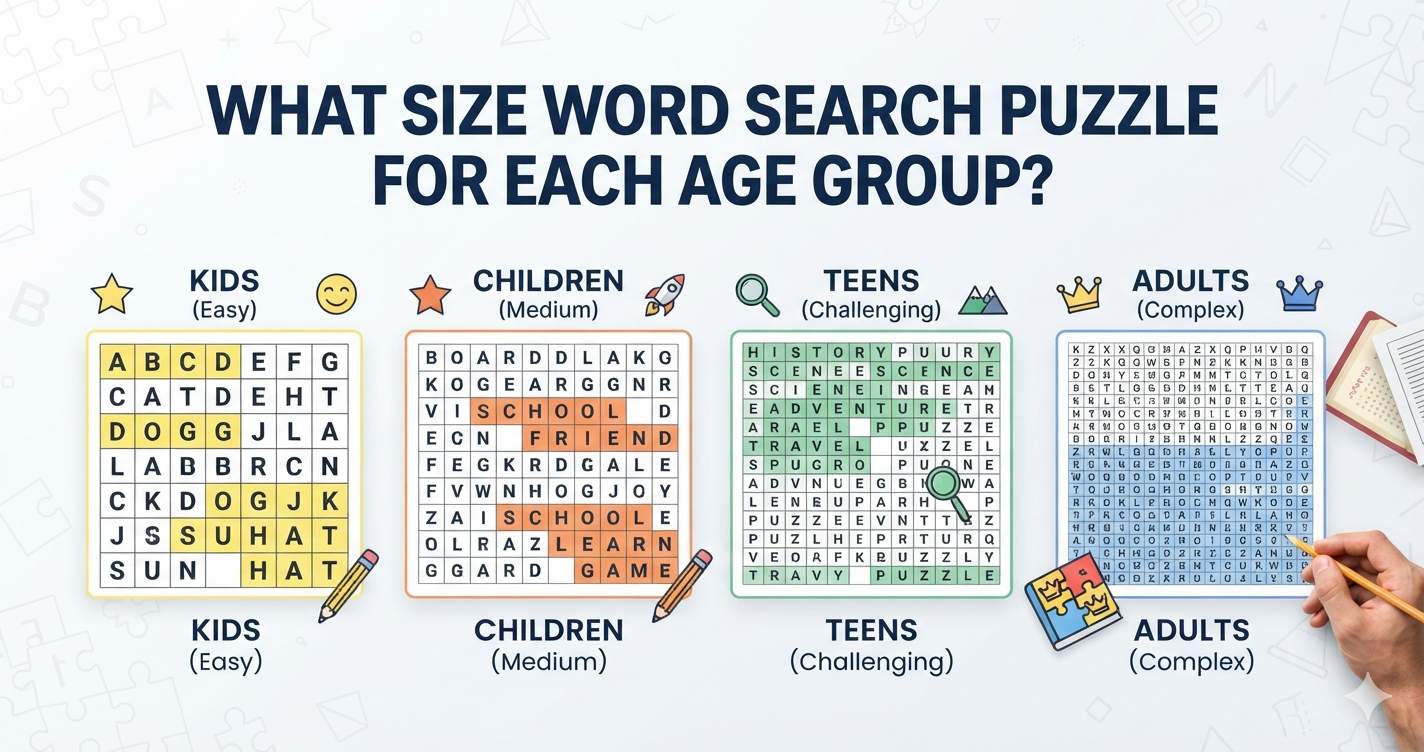
Most word search makers let you pick any grid size and enter any number of words, then quietly fail when the two do not fit. The puzzle still prints. It just has three of your words missing, or a grid so dense that finding anything is guesswork.
This article gives the numbers we measured on our own generator, so you can choose a size on purpose instead of by trial and error.
How many words actually fit
Capacity is not linear with grid size, because words have to cross empty space without colliding. We ran the placement engine repeatedly at each size and recorded where it started dropping words.
| Grid | Comfortable | Maximum before words get dropped |
|---|---|---|
| 10×10 | 8–12 words | ~12 |
| 15×15 | 15–25 words | ~25 |
| 20×20 | 20–30 words | ~30 |
| 30×30 | 60–90 words | ~110 |
Word length matters as much as word count when you build the grid. Ten words of four letters fit easily in a 10×10; ten words of nine letters do not, because a nine-letter word needs a clear run of nine cells and there are only a few of those in a small grid.
A practical rule: the longest word must be at least two cells shorter than the grid is wide. In a 10×10, keep the longest word to eight letters.
The density trap
There is a second limit that has nothing to do with whether words fit. Once the grid is packed, the random filler letters between words start forming your words by accident, and the puzzle becomes ambiguous.
We measured where this begins: around 68% fill — there is a whole guide to that threshold. Below that, a solver who finds a word has found the right one. Above it, false matches appear and the answer key stops agreeing with the grid.
If a generator does not warn you at that point, it is not checking. Ours re-rolls the grid until the accidental matches are gone.
Which size for which age
Ages 4–6 — 6×6 to 8×8
Horizontal and vertical only, no diagonals, no backwards. Four to six words, all short, all from one obvious theme so the child can predict what they are looking for. At this age the win is recognising letters in sequence, not searching.
Ages 7–9 — 10×10 to 12×12
Add diagonals but keep words running forwards. Eight to twelve words. This is the size most classroom worksheets use, and it fits comfortably on half a page next to an instruction line.
Ages 10–13 — 15×15
All eight directions, backwards included. Fifteen to twenty-five words. Vocabulary lists from a lesson work well here because the words are already related, which makes the puzzle feel like revision rather than a chore.
Teens and adults — 20×20 and up
Twenty to thirty words at 20×20. Go to 30×30 only for a themed puzzle with a long word list — sixty words or more — otherwise the grid is mostly filler and the search is tedious rather than hard.
Making it harder without making it bigger
Grid size is the blunt lever. These change difficulty at a fixed size:
- Backwards words roughly double the search time for most solvers.
- Diagonals add more difficulty than backwards words, because the eye scans rows and columns naturally but not diagonals.
- Filler letters drawn from your own word list rather than the whole alphabet make the grid far harder — every letter looks plausible.
- Removing the word list entirely and giving only a theme is the hardest variant, and it fits a puzzle book better than a classroom.
That third one is worth understanding. If your words are ELEPHANT, GIRAFFE and ZEBRA, a grid filled only with the letters in those words gives no visual shortcuts. It is the single cheapest way to make an adult-level puzzle.
Printing
For a classroom handout, US Letter at 300 DPI with half-inch margins prints cleanly on any school printer. For a book interior, the same page needs a wider inner margin for the gutter — 0.375 inch minimum for a 24 to 150 page book, more beyond that.
Export as PDF rather than PNG when the destination is print — the format guide covers which to use when. A PNG is fixed at whatever resolution it was captured; a PDF keeps the text as text and stays sharp at any size.