Corporate icebreakers have a reputation, and it is earned. The failure is nearly always the same: the activity asks adults to perform enthusiasm in front of colleagues, and adults would rather not.
A puzzle sidesteps this. It gives people something to look at other than each other, and it produces conversation as a side effect rather than as a requirement.
What makes one work
- It can be ignored. Anyone who wants to sit it out can, without that being visible.
- It is short. Under ten minutes, or it becomes the meeting.
- It has a right answer. Adults will engage with a puzzle far more readily than with a discussion prompt.
- It is about them, not about the company. Nobody warms up to a word search of the corporate values.
That last point is where most attempts fail. A puzzle made of mission-statement vocabulary reads as an exercise in compliance. A puzzle made of the team's own names, offices and in-jokes reads as someone having paid attention.
Three that hold up
Find someone who — as bingo
Squares like 'has worked here longest', 'has been to more than five countries', 'plays an instrument'. Players fill squares by finding the colleague who matches. It is the only version of this that gets a room of strangers moving without anyone having to stand up and introduce themselves.
Twenty-four squares, one card each — the bingo maker generates a different arrangement per person so nobody can copy their neighbour.
Team word search
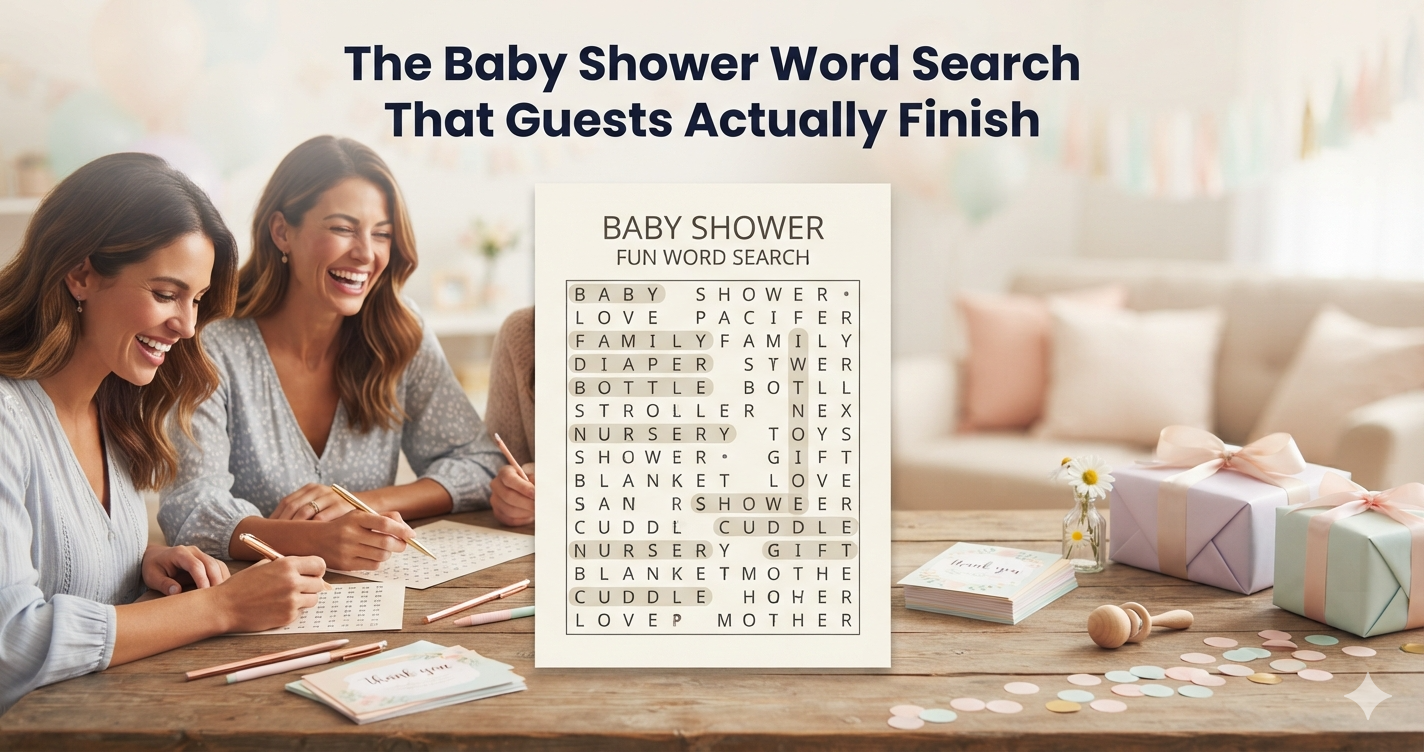
Names of everyone in the room, hidden in a grid. Sounds trivial and works consistently, because finding your own name and then someone else's is a low-effort reason to start talking.
Keep it to a 12×12 with ten or twelve names — people are holding coffee.
Crossword about the team
The most work to prepare and the best received. Clues drawn from things the team actually knows: 'the meeting room nobody can book', 'what the deploy script is named after'.
It only works if the clues are genuinely insider. A crossword of generic office vocabulary is a worse version of the word search.
For a remote team
Send the puzzle as a link rather than a file. People play it in the browser, no download and no account, and you can see who has opened it.
It also removes the worst part of remote icebreakers, which is the silence while everyone waits to be called on. People solve at their own pace and the chat fills up on its own.
The thing not to do
Do not make it competitive with a prize in front of a room where people report to each other. It changes the dynamic from a shared distraction into a performance, which is precisely the thing everyone was trying to avoid.