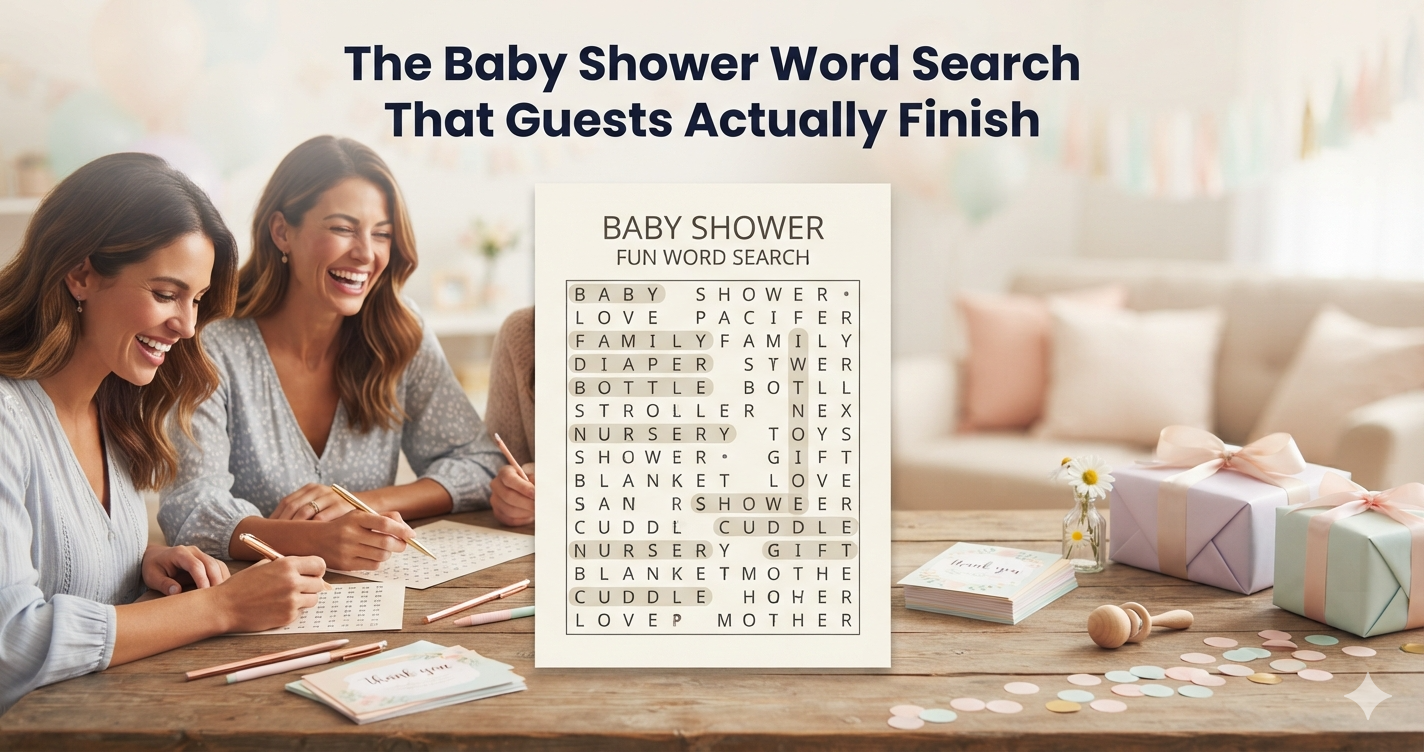
Every wedding has the same dead hour: the couple has gone for photographs, the food has not arrived, and eight people who have never met are sitting at a round table discovering they have nothing in common.
A puzzle on the table solves this better than it has any right to — not because people want to do a puzzle, but because it gives strangers something to point at.
Make it about the couple, or do not bother
A generic wedding word search — BRIDE, GROOM, CAKE, RINGS — gets glanced at and put down. It is the same puzzle they could have had at any wedding, and everyone can tell.
Words that work:
- The town where they met, and the one where they live now
- The name of the pub, restaurant or app that started it
- Both sets of parents' first names
- The honeymoon destination, if it is not a secret
- The dog. There is almost always a dog.
The table then does the thing you actually wanted, which is to talk. Half the guests know what one of those words refers to and the other half ask.
Practical details people get wrong
Keep it short — eight to ten words. Guests are in formal clothes, holding drinks, at a table with limited space. This is not a sitting for a 20×20 grid.
Print one per person, not one per table. A shared sheet means one person does it while seven watch.
Put the answer key with the toastmaster or the best man, and have them read it out later. It turns the puzzle into a moment in the evening rather than something that quietly ended.
And print on the heaviest paper you can. A table puzzle on thin paper looks like a leftover from the printer; on card it looks like part of the stationery.
Two variations worth stealing
Use the puzzle as the place card — the guest's name printed above the grid. It removes a piece of stationery and guarantees everyone has one in front of them.
Or give each table a different puzzle and a small prize for whoever finishes first. It costs a bottle of something and it gets a room of strangers cooperating within about four minutes.